We offer a full range of repair services for your accordion

From replacing broken reeds to servicing and tuning no job to big or small
All our repairs are carried out by fully trained personnel to the highest possible standards
All mechanical repairs such as air leaks, lifted keys, stubborn switches, stuck buttons, bass mechanism problems etc.
All reed work such as replacing broken reeds, re-waxing, leathering, and reed block repairs.
Tuning – Straight, double octave and Tremolo or Musette to your specification
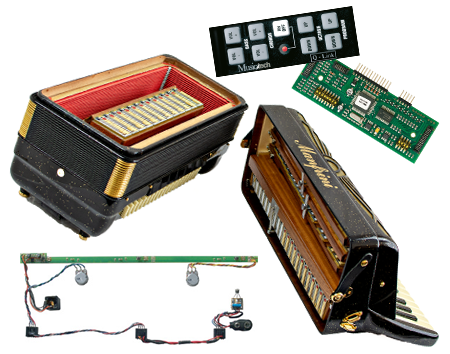
MIDI installations, alterations and repairs
Microphone pick-ups installed and repaired
New bellows, straps, cases, brackets, fittings, bags,
From the smallest job to complete restorations
Our estimates are free and Collection is available via courier which costs £30 each way

For electronic & MIDI repairs please include your power supply and cables.

To arrange your accordion repair please call 01698 844801

Have full MIDI treble and bass fitted to your accordion from £899 (Master Sound)

Wireless Upgrade for £399 available for many systems

To arrange your please call 01698 844801

Wireless accordion MIDI

Accordion repairs

Accordion FAQ

Stradella Bass System – is the standard layout on the bass side of most piano and chromatic accordions, it uses columns of buttons arranged in a circle of fifths; this places the principal major chords of a key (I, IV and V) in three adjacent columns. Each column contains, in order:
The major third above (or minor sixth below) the root (“counter-bass”)
The root note
The major chord
The minor chord
The dominant seventh chord
The Diminished seventh chord
The following chart shows a standard 120-button Stradella layout.

Free Bass

Unlike the Stradella-bass system, all of the buttons on a free-bass keyboard play single notes. The free-bass also has a bigger range of notes than the Stradella system. Due to this, the free bass system is used more often to play serious classical music.

Convertor bass systems can switch between the Stradella and free-bass system, while some accordions have free-bass only or auxiliary free-bass rows in addition to the Stradella buttons (sometimes called a bassetti).

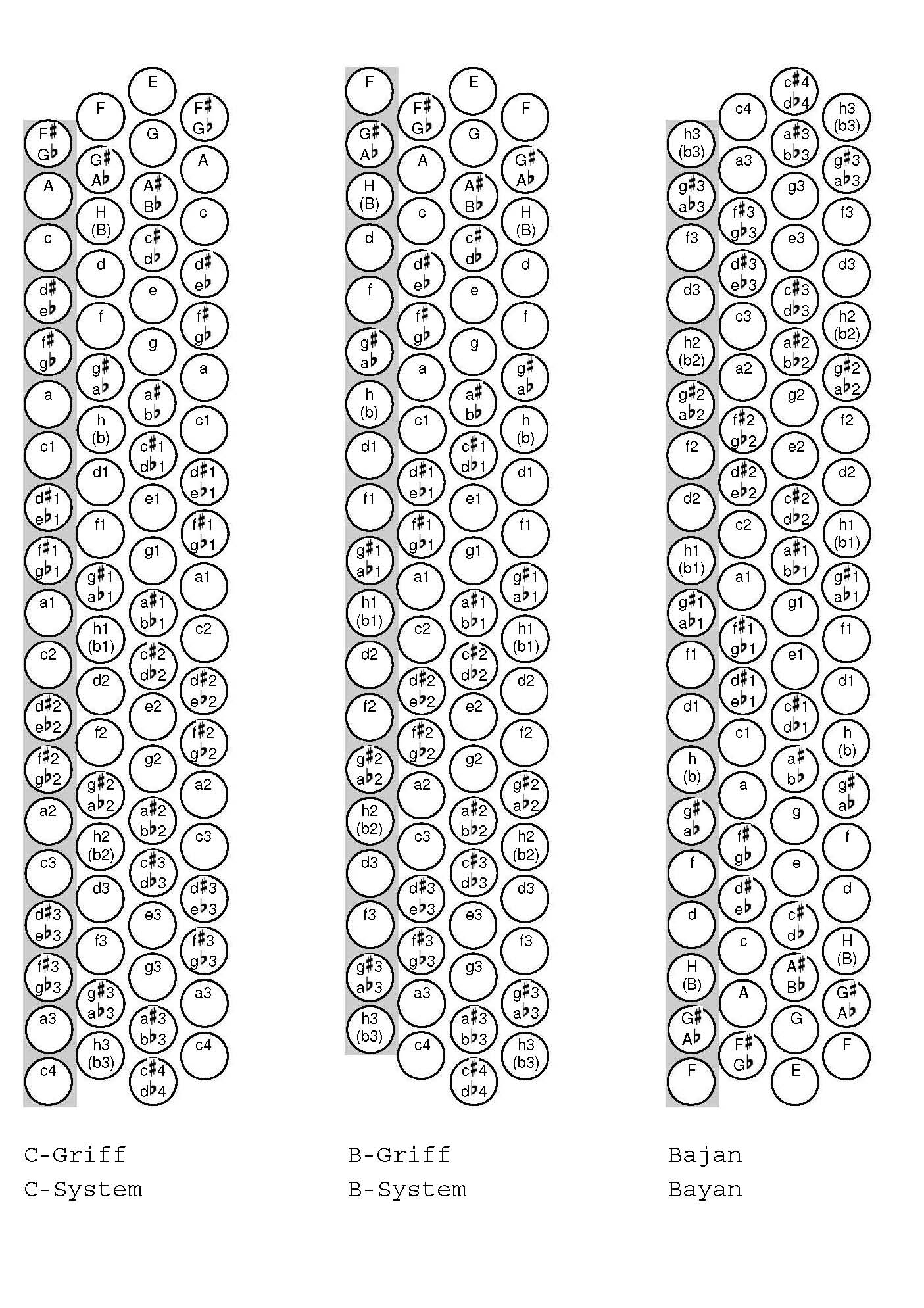
There are three main systems B, C and Bayan.

Chromatic Button accordion –  with a keyboard consisting of rows of buttons arranged chromatically. There are three main systems B, C and Bayan.
There can be 3 to 5 rows of horizontal treble buttons. In a 5 row chromatic, two additional rows repeat the first 2 rows to give options in fingering.

Diatonic Button accordion – or melodeon is a type of button accordion where the melody-side keyboard plays a different note in each direction .
The bass side usually contains the principal chords of the instrument’s key and the root notes of those chords.
The available notes on the melody side are based on different keys. For example, you could have a 1-row melodeon in the key of G. This would give you the notes G/A – B/C – D/E – F#/G spread over 4 buttons. Commonly used melodeons nowadays include the D/G box with 2 rows, used especially in English traditional music, while instruments in G/C, C/F or G/C/F (with three treble rows of buttons), are widely used in France, Italy and central/eastern Europe.
Irish traditional musicians generally favour instruments in B/C or C#/D.
There are many variations on these layouts, with 2½ row melodeons (a.k.a. “Club” system after the Hohner originals, accidentals and various options which players sometimes customize to suit their own requirements.
More information on melodeon’s is available on this website http://info.melodeon.net

Parts of the accordion

The accordion consists of two wooden boxes joined by a bellows. These boxes house the reed blocks for the right and left hands. Each side has grilles in order to allow air in and out of the instrument, and to allow the sound to better project.

Bellows
The bellows is the most recognizable part of the accordion, they are made from pleated layers of cloth and cardboard with added leather and metal. The frames of the bellows usually made of wood are glued to the bellow and fit inside the body of the accordion with a thin gasket between the frame and the body to create a seal, usually held in place by pins but sometimes screws.

©2026 Accordion.co.uk all rights reserved. Scotland's new / used accordions - Accordion repairs - MIDI Accordion Shop - Accordion.co.uk